Rosetta Stone Review for Adults Who Need to Speak
What picture immersion trains well, why adults stall when a pattern stays invisible, and a describing drill you can steal without buying the method.
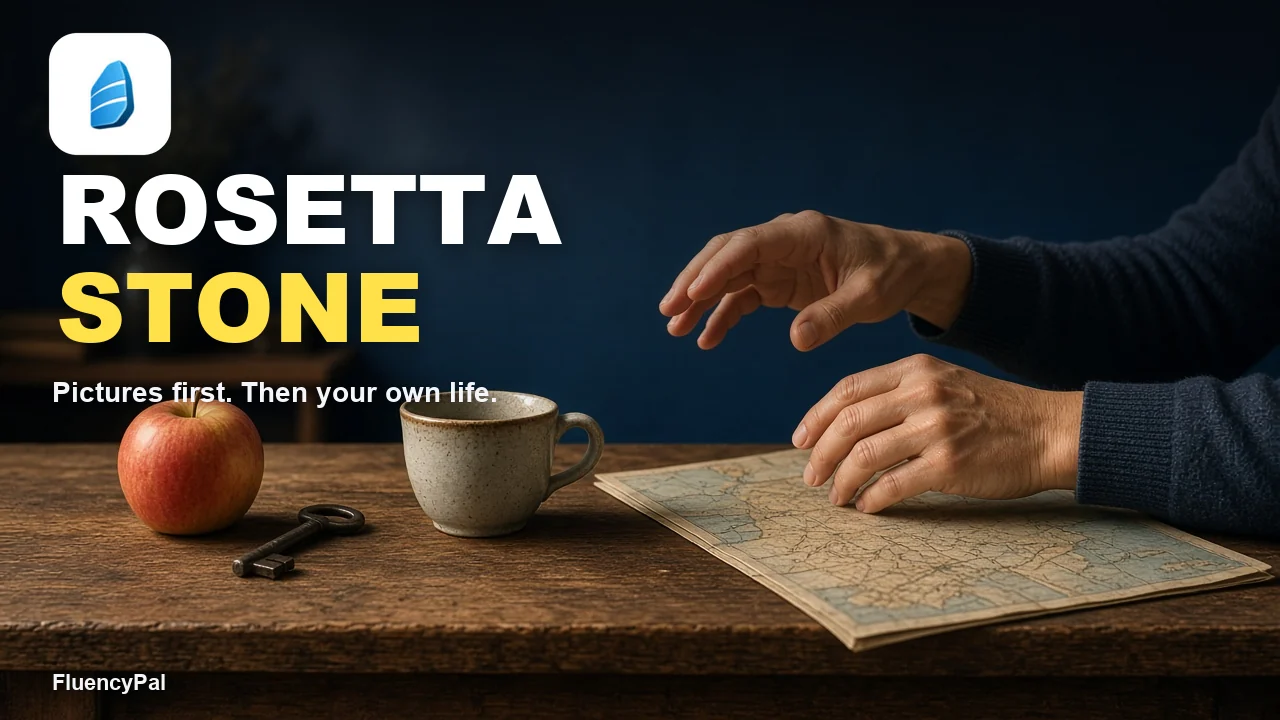
Rosetta Stone's promise is immersion. You see a picture, you hear a phrase, you are not handed a translation in your first language. For some beginners this is a relief. The phone is not a dictionary with pictures. It is a set of patterns you are supposed to feel. For many adults with a job and a limited evening, the same design becomes a stall: they can tell the apple from the boy, and they still cannot explain a problem at work.
This review is about that trade. The brand's exact screens change. The idea — meaning from context, little or no translation, a lot of recognition — is stable enough to judge.
What the method is good at
Picture immersion trains you to attach sound to a situation without detouring through your first language. That detour is a real habit. If every new sentence must be translated in your head before you accept it, you will be slow in conversation. A method that refuses the translation can loosen that habit.
It also keeps the early vocabulary concrete. Objects, actions, simple relations. You are less likely to memorize abstract word lists you cannot picture. And the better versions of this method ask you to speak, not only tap, so the phrase passes through your mouth.
If you are a beginner who over-thinks grammar and you like puzzles, this can be a good first month. You are learning to tolerate not knowing the rule yet. Some people find that calming.
Why adults stall
Adults are not only learning apples. They are learning to ask a landlord for a repair, to tell a doctor where it hurts, to say why a project slipped. Those sentences are abstract, and the picture method is slow to reach them. While you wait, a few things happen:
- A pattern is invisible. You have seen it twelve times and you still do not know if you may change the tense. A one-sentence explanation would have saved a week. Adults are allowed to want the explanation. Wanting it does not make you a bad language learner. Courses that include notes are reviewed in is Babbel good for speaking?. Audio courses that also withhold the textbook feeling are in Pimsleur review.
- The pictures are the course's life, not yours. You can label their kitchen. You cannot tell someone about yours, because nobody asked.
- Speaking stays prompted. You say the phrase that matches the picture. Take the picture away and the phrase often goes with it.
- The sessions are long and same-shaped. Busy adults quit same-shaped sessions. A plan that admits ten-minute days is in language apps for busy adults.
None of this requires you to mock the method. It requires you to notice whether your goal is "trust my ear with simple scenes" or "say the thing that happened today."
Steal the best drill
The part worth keeping, even if you never subscribe, is describing a picture out loud without translating.
- Put three objects on a table. A cup, a key, a piece of fruit. Or open a photo from your phone of a real place you were.
- Set a timer for three minutes.
- Describe what you see, in English, without stopping to write a translation. If you miss a word, point with language. "The thing you open a door with" is a success. Silence while you look the word up is a pause you can take after the timer.
- Then, and only then, look up one missing word. Say the description again in sixty seconds, with that word inside it.
- Add one sentence that is not in the picture: a memory or a preference. "I lost a key like that last winter." The picture was the ramp. The memory is the speaking.
Do this three times a week. Use a different photo. Your own photos are better than stock fruit, because the detail is yours. "The blue bowl is chipped. My sister gave it to me." No immersion app knows about the chip.
If you want a scene instead of a still life, describe what you would say in the place. A shop is a natural one. FluencyPal's grocery store role play lets the picture talk back: they do not have the item, you need a substitute, you have to leave the labels behind. Speaking with AI can do the same with a photo you describe at the start of the call. "I will describe my kitchen. Ask me one question when I stop."
When translation is a tool, not a sin
Refusing translation entirely is a rule inside a method, not a law of learning. If a single word blocks a story you care about, look it up and say the story. The damage comes from translating every line before you will speak, and from reading your first language as a subtitle for the whole evening.
A reader with tap-to-translate, such as FluencyPal Books, is the opposite tool used on purpose: you stay in a book, you translate the word that stopped you, you continue. That is for reading. Do not confuse it with the three-minute description drill. Both are legitimate. They train different hours.
Who should pay
Pay for a picture-immersion course if you are early, you like the puzzle, you will speak the prompts aloud, and you will add the memory sentence so the pictures do not become your whole English. If you will not add that sentence, you are paying for a pleasant recognition game. Recognition matters at the start. It is not the speaking goal forever. The test for any app is in best apps to practice speaking English.
Do not pay if you already tell simple stories and you are stuck making them longer and clearer. You do not need more apples. You need the plateau work in the intermediate English plateau, which is mostly output.
FluencyPal is not an immersion picture course and will not pretend to be one. It starts being useful when you can attempt the description drill and you want a follow-up. The free plan has limited speaking messages. Paid Practice access is one payment with no auto-renew. See pricing. A voice memo of the three-minute description is a complete practice on the days you do not want a follow-up.
More guides
About this guide
FluencyPal publishes this article, and FluencyPal is one of the tools it describes. There is no star rating here, and no invented price for another company. Lesson lists and prices change. Read the product's own page before you pay. Judge a tool by the action it asks for in fifteen minutes: tap, listen, read, or speak.
Author: Alex Dmowski
Co-Author: Grok 4.7 (Drafting and editing)
Published on: November 3, 2026