How to Introduce Yourself
When a group is waiting: your name, one fact that belongs in the room, and a detail someone can ask about.
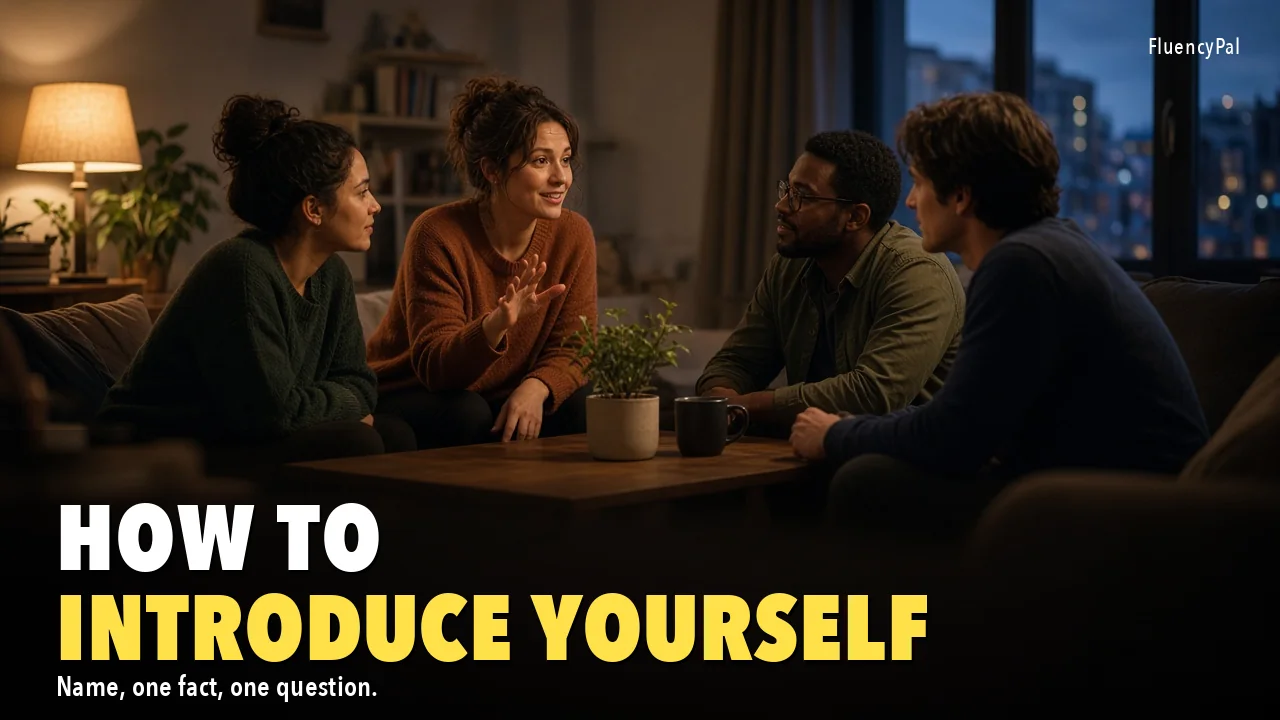
Someone points at you and says, "Introduce yourself." A class, a new team, a language exchange, a video call where your square just lit up. You have the room for half a minute. What usually comes out is a life story that starts with "so, a little about me" and ends when you notice people looking at the table. They asked for a way to remember you and a way to talk to you next.
The twenty-second version for one person at a door is a different moment. That one is how to introduce yourself in English: name, one line, why you are here, a question. Use it when you are meeting a single person. This page is for the circle, when several people are waiting and you are the one talking.
The shape
Four pieces. Twenty-five to forty seconds. Then stop.
- Your name, as you want it said. Then a short pause. If people often miss it, give them a second pass. "I'm Bhaskar. Baskar is fine."
- One fact that belongs in this room. Why you are here, or what you will do here. One of those, not a hobby and a hometown stacked on top.
- One detail a person can ask about. A situation, a start date, a kind of conversation you want. Specific enough to become a question.
- A clean ending. "That's me." Or look at the next person. A trailing "yeah, so, that's kind of it, I guess" spends the last five seconds on nothing.
I'm Lena. I started this class in September because I freeze on work calls. I work at a hotel, mostly evenings. That's the part I want to practice.
A person can ask about the calls or the hotel. Both are real. You gave them a person, and you kept the apology for your English out of the opening. You had not spoken yet. There was nothing to apologize for.
Three rooms
A class or a language exchange. The fact is why you are learning, tied to one situation. "I need English for the parents at my daughter's school" gives the group a person. "I love traveling and meeting people from different cultures" could be anyone in the circle.
A new team. The fact is the team, the day you started, and what you will actually do this week. "I'm Marco. I joined support on Monday. I'll be on the evening chats. I was at a smaller shop before this." Leave the tour of your career for the person who asks. When you need a longer job line, use how to describe your job in English.
A video call where nobody knows you. Same shape, shorter, because the tile is small and people are reading your mouth. "I'm Priya, I'm in Leeds, and I'm here for the Friday review. I'll mostly listen today." Say the name, then the reason you are on the call. Wave once if the room is informal. Wave and talk at the same time and the name gets lost.
Lines that spend the minute before you start
These feel polite. They are empty. Cut them.
- "So, a little bit about me..."
- "Let me introduce myself." You already are. The name is the introduction.
- The school worksheet: age, city, job, hobby, favorite food. In a room of adults, keep the name and two items that belong here. Favorite food can stay home unless the room is a kitchen.
- "Sorry, my English is not very good." If you want a hedge, put it on one word later, not on your whole self. What to do when you forget an English word is for the middle of a sentence.
A true beginner class sometimes asks for the worksheet. Even then, say the name slowly and drop one item. Five facts in a row is a form. Two facts is a person.
If they want longer than forty seconds
"Tell me about yourself" at a hiring interview is its own genre. Keep that speech for the panel. Prepare it with English job interview practice. A birthday gets the short version from the other guide, not the panel version.
When a host says "take a minute" and means it, add one past fact that explains the present, then one aim, then stop.
I'm Lena. I work the evening desk at a hotel. I moved to this city two years ago, and the phone calls are still the hard part. I'm in this class to get through a booking change without switching to my first language. That's what I'm working on.
That fills a minute. A second job, a degree, and a travel story will push you toward two, and the next person is already composing their own speech. They are not storing yours.
The people who went before you
You will forget their names. Ask in the first ten minutes. "Sorry, tell me your name again" is ordinary then. It gets heavier later.
If you speak second or fifth, you can hook onto the previous person. "Samir is in the morning class. I'm Lena, I'm in the evening one." You both become easier to remember. Do this when you heard the name. A guess in front of the group is a worse start than a plain one.
When the circle comes back with a question, answer in two sentences and return one question. That is small talk, and it is why you left a detail they can pick up. A job title alone invites "so what do you do?", which you already answered.
Practice it on your feet
Write the four pieces for a room you will actually enter. Say them standing up. A seated reading voice drops the name. Time it. Past forty-five seconds means a second biography got in. Cut the fact. Keep the pause after your name.
Record one take on your phone from across the room, as if the circle were noisy. If a stranger could not catch your name, redo the name and the pause. Three takes is enough. Keep the one you would say in front of people you want to see again.
Then change the room. The hotel version and the new-team version are different paragraphs. The fact has to belong. One all-purpose paragraph is usually the interview speech, and people can hear that.
Small talk with a stranger will not wait politely for the whole speech, which is useful. Give the four pieces, then follow whatever they ask. On Speaking with AI you can do the same minute and stop. A daily lesson is a different drill: one pattern, then a couple of minutes of talking. Use the lesson for a pattern. Use this page when you want the introduction itself to come out in one piece.
The free plan includes a limited number of speaking messages. Paid Practice access is one payment and does not auto-renew. Current amounts are on the pricing page.
More guides
Author: Alex Dmowski
Co-Author: Grok 4.7 (Drafting and editing)
Published on: November 6, 2026