How to Introduce Yourself in English
Four beats for a first meeting: name, what you do in one line, why you are here, and a question that is easy to answer.
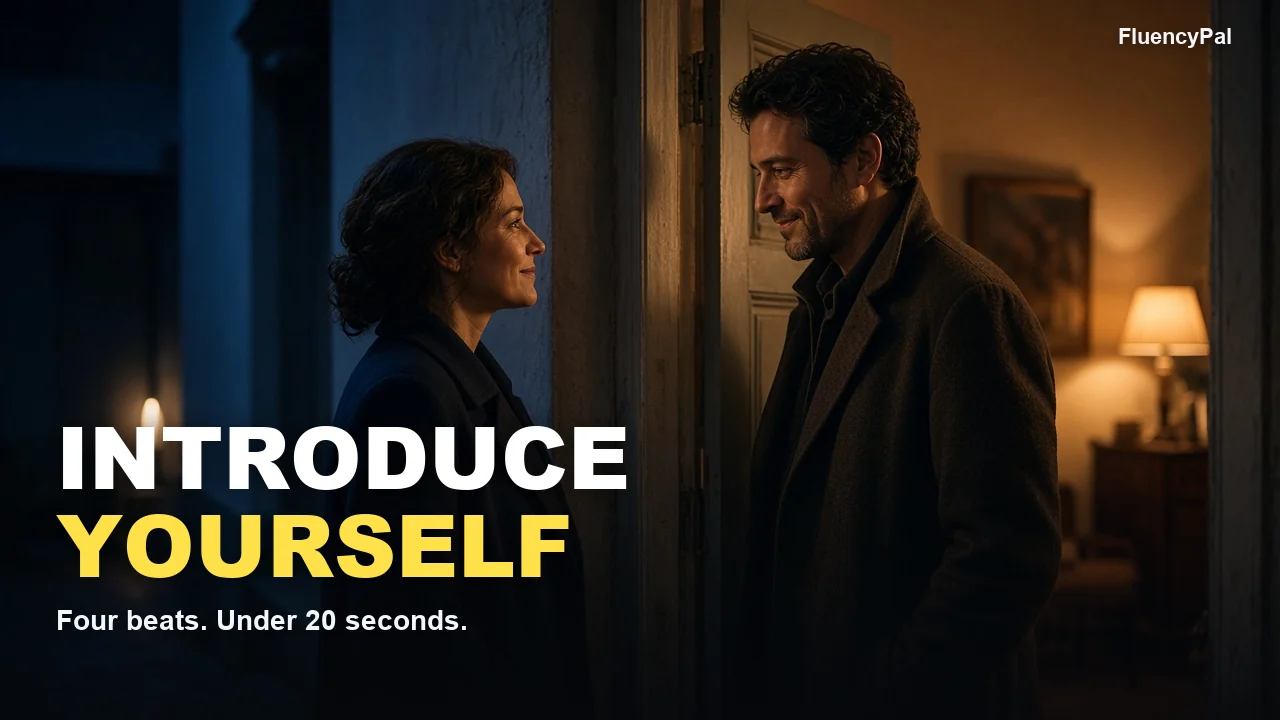
An introduction fails in a predictable way. You say your name too quietly, then you offer your job title as if it were a personality, then you run out. The other person says their name, which you immediately lose, and both of you look at the snack table. A useful introduction is four beats and under twenty seconds. You can have a longer version for an interview. Do not use the interview version at a birthday.
The four beats
- Your name, as you want it said. Then stop for a second so they can have it. If it is often misheard, offer a spelling or a short handle. "I'm Bhaskar. People say Baskar. That's fine."
- One line about what you do or who you are here. Not both biographies. Pick the one that belongs in this room.
- Why you are in this room. The host, the class, the office, the friend who invited you.
- A question they can answer without thinking. How they know the host. Whether they have been here before. If they came from nearby.
I'm Lena. I sit with the support team. Maria invited me. Have you been to one of these Fridays before?
That is enough. If they answer, you are in small talk, and you already have a follow-up waiting. If they only say their name, repeat it once. "Samir. Nice to meet you." Repeating the name is how you keep it. It also gives them a second to find their own line.
The job line has to be human
"I'm in ops" is a closed door. Use the ten-second job description from how to describe your job in English: the result, and who it is for. "I help new shops when a payment fails." Then the question. Do not add your tools unless they ask.
At a class, the job can wait. "I'm Lena. I'm in the evening class. I started in September. Are you in this class or the morning one?" Same four beats. Different nouns.
At a hiring interview, beat 3 changes. You are here because you want the role, and you need one proof. That version is longer and it is a different genre. Prepare it with English job interview practice. Do not recite it at a party because it is the introduction you have practiced most. People can hear a script that was built for a panel.
If you forget their name
It will happen. Ask early, not twenty minutes later.
- Sorry, tell me your name again.
- I heard Samir. Is that right?
Asking early is ordinary. Waiting and then avoiding their name for the rest of the night is what makes the next sentence stiff. You can also introduce them to someone else only when you are sure. Getting a name wrong in front of a third person is worse than a private repeat.
Practice so the first beat is loud enough
Record the four beats on your phone, standing up, as if the room were noisy. Play it back. If your name is the unclear part, that is the only thing to fix. Say the name, pause, then the rest. Do three takes. Keep the one where a stranger could spell you, or could at least ask for the spelling because they heard a real attempt.
Then do it with a surprise. Ask someone to answer your question with something short and dull. "Yeah." Your job is one follow-up, not a new speech. "Yeah, you've been before, or yeah, you know Maria?" The follow-up skill is the whole of how to ask follow-up questions.
Small talk with a stranger will give you a person who does not follow your four beats, which is what real people do. Use the beats anyway. They are a spine, not a script the other person signed.
A version for writing
Email and chat introductions can be the same four lines, with the question at the end. "I'm Lena from support. Maria said I should write to you about the Friday list. Is the list the one from last month, or a new one?" Spoken and written introductions fail for the same reason: too much identity, no question. The question tells the other person how to start.
More guides
Say one example out loud
Pick one line from this page and change it so it is about your day. Say it once without reading. If you want a follow-up after that, FluencyPal can continue in a call or a voice message on Speaking with AI. A daily lesson stays on one pattern, then asks you to talk for a couple of minutes. The free plan includes a limited number of speaking messages. Paid Practice access is one payment and does not auto-renew. Current amounts are on the pricing page.
Author: Alex Dmowski
Co-Author: Grok 4.7 (Drafting and editing)
Published on: November 3, 2026