How to Ask Follow-Up Questions in English
The second question is what makes you a conversation partner. Steal a word they used, ask for a time or a reason, and leave them a way to answer.
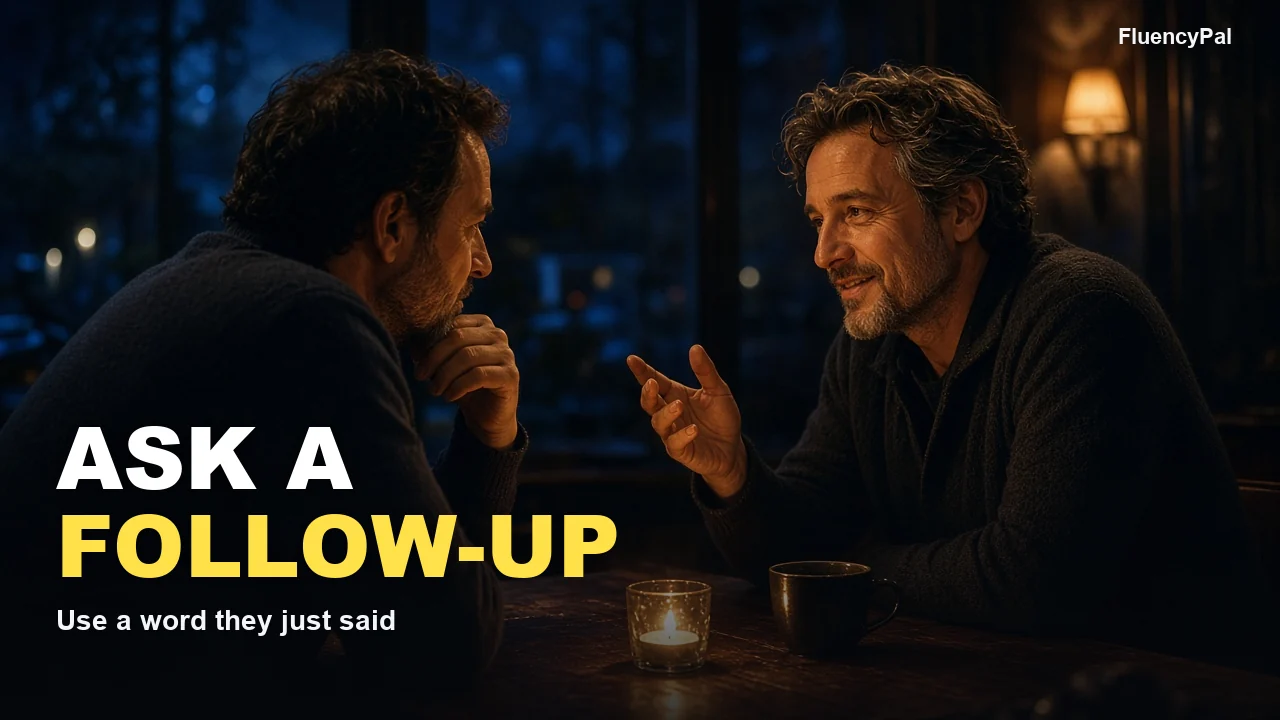
The first question is easy to memorize. "How was your weekend?" The conversation dies on the answer. "It was fine." A follow-up question uses something they just said, so it cannot be fully memorized. That is why it feels harder, and why it sounds like interest instead of a script. You can learn the shapes. The words come from them.
Three shapes
Steal a word. Repeat one piece of their answer and ask about that piece.
Them: I was in Porto. You: Porto. Was that for work, or a holiday?
Ask for a time, a place, or a person. "Fine" hides all three. Pull one into the open.
Them: It was busy. You: Busy at work, or busy at home?
Ask for a reason or a feeling, after you have a fact. Feeling questions are heavy if they are first. They are natural once you know the fact.
Them: I left the job. You: How long were you there? Them: Four years. You: Did you want to leave, or did it just end?
You do not need all three. One follow-up is already more than most nervous conversations contain. Two is generous. Five in a row is an interview. Stop and offer a piece of your own life, or the other person will feel examined. A piece of your life can be one sentence. "I was in Porto once. I got lost in the station." Then they can ask you. That trade is the conversation.
Questions that are easy to answer
Early on, ask for things people can say without a confession.
- Which part of the city?
- Do you go there often?
- Was the train direct?
- Who did you go with?
- What did you eat?
Save "why did you really quit?" for someone who has already opened that door. English small talk is the map of what is too heavy for minute one. Follow-ups are how minute one becomes minute five without a new topic from nowhere.
If you want a deeper second meeting, you still start with a word they gave you. The heavier questions in deep questions to ask land better after a fact, not instead of one.
When you do not understand the answer
A follow-up can be a repair. That still counts as interest.
- Sorry, the station or the office?
- You said "shift." Do you mean the night shift?
- I missed the name. Who was that?
Guessing a specific option is better than "what?" because they know which word to repeat. This is the same move as on the phone. English phone call phrases has the longer version. In a room you can also point. "This part. The date."
Practice with dull answers
Dull answers are the gym. Ask a friend, or yourself, to reply with almost nothing. "Good." "Porto." "Busy." Your only job is one follow-up from the shapes above. Do ten. Record three. Throw away any follow-up that could have been asked without their answer. "How was your weekend?" after they already said "Porto" ignores them. "What did you do in Porto?" could not exist without their word. That is the test.
Then switch roles. You give a short answer and notice whether you left them a word to steal. "It was fine" leaves them nothing. "It was fine. I slept a lot" leaves them "slept." Help the other person a little. Conversation is not only questioning. A short opinion with an example, from how to give an opinion in English, gives them something to pick up.
Small talk with a stranger will answer you in full sentences sometimes and in fragments sometimes. Practice the fragment. The full sentence hides whether you can follow up.
A limit
Not every silence needs a question. Sometimes the person is done, or the elevator is done. "It was good to hear that" and a stop is complete. Follow-ups are for the moment you want to continue and you do not know how. They are not a tax on every sentence another human says. If you are tired, one stolen word is enough. You do not have to host the evening.
More guides
Say one example out loud
Pick one line from this page and change it so it is about your day. Say it once without reading. If you want a follow-up after that, FluencyPal can continue in a call or a voice message on Speaking with AI. A daily lesson stays on one pattern, then asks you to talk for a couple of minutes. The free plan includes a limited number of speaking messages. Paid Practice access is one payment and does not auto-renew. Current amounts are on the pricing page.
Author: Alex Dmowski
Co-Author: Grok 4.7 (Drafting and editing)
Published on: November 3, 2026