How to Give an Opinion in English
Opinion, reason, example. How to sound clear without a speech, and how to change your mind in one sentence.
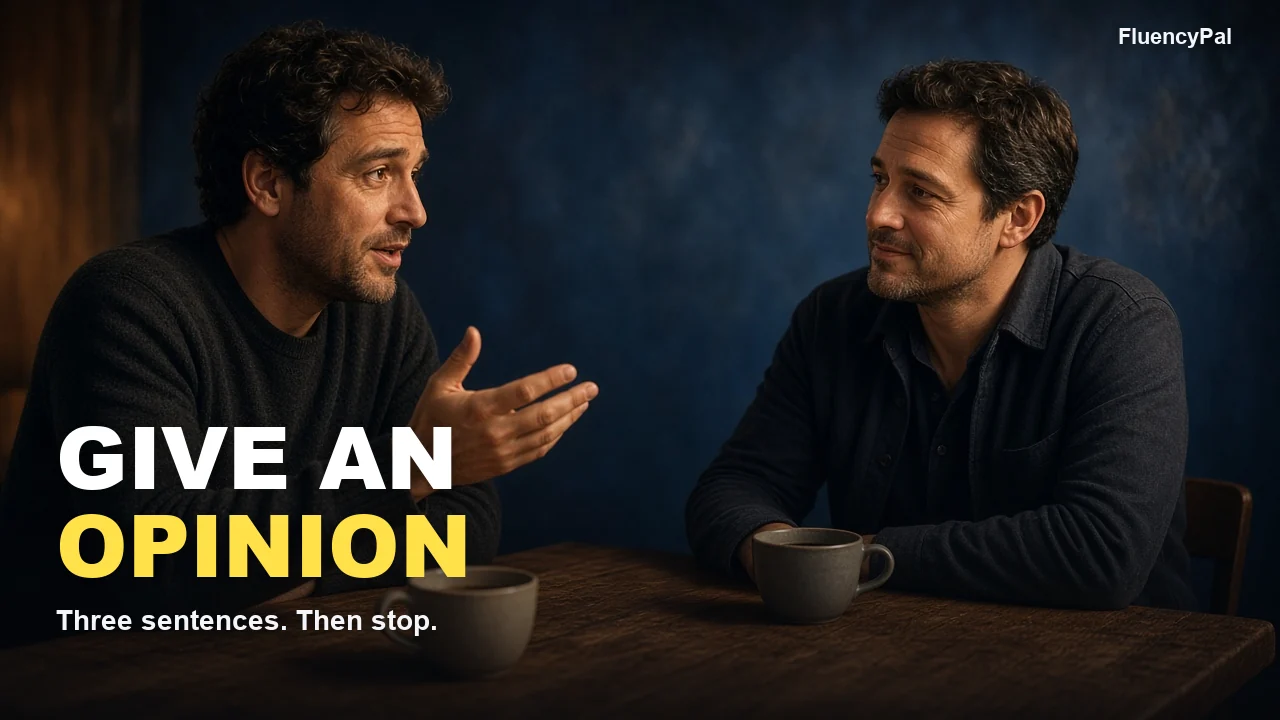
An opinion in conversation is not a thesis. It is a position another person can answer. Learners often do one of two things. They hide the position inside "maybe it depends, I don't know," so nobody can answer. Or they build a speech, so nobody can enter. A better opinion is three sentences and then a stop. The stop is what makes it a conversation.
Three sentences
- The position. What you think, in one clause. Not the history of how you came to think it.
- The reason. Because, one cause.
- The example. A time, a person, or an object. Something the listener can picture.
I think we should meet in the morning. People are sharper then. Last Thursday the four o'clock meeting forgot the second topic.
You can say this about films, food, remote work, or a deadline. The shape does not care about the topic. If you cannot find an example, you may not have an opinion yet. You may have a mood. "I don't like it" is a start. The example is what lets the other person talk to you instead of to a fog.
Phrases that open the position, if "I think" feels thin:
- I feel...
- For me...
- I'd rather...
- The way I see it...
Use one. Stacking "I think I feel like for me" is a filler wearing three coats. See English filler words if that stack is familiar.
Soften without deleting the point
Softening is for the relationship, not for hiding.
- I'm not sure, but I think the morning is better.
- This may only be true for our team.
- I could be wrong about the Thursday meeting.
The position is still there: morning is better. If the softening removes the position, you have gone too far. "Whatever you think" is not an opinion. It is a way to leave. Use it when you truly have no stake. Do not use it when you do.
In a meeting, the same shape gets a slightly clearer edge. "I see it differently" plus the reason is in English phrases for meetings. At dinner you can be warmer and keep the three sentences.
Answer someone else's opinion
Do not leap to your view and abandon theirs. One line of contact, then your three sentences if you still need them.
- I see what you mean about afternoons. I still prefer mornings, because...
- That's true for the design. For the testing, I had a different week.
- I haven't thought about it. Give me a second.
"Give me a second" is better than a fake opinion. You can also ask them to expand before you judge. How to ask follow-up questions keeps you from turning every chat into a debate you did not want.
If you change your mind, say so in one sentence. People trust it.
- You're right about Thursday. I forgot we had the client call.
- I changed my mind. Morning is worse if the team is in another time zone.
You do not need to narrate the change. The new position is enough.
Practice on opinions you already have
Pick five topics you can speak about without research: a meal you like, a rule at work, a way of traveling, a kind of meeting, a habit. For each, say the three sentences out loud. Record two of them.
Then do the hard version. Take the position you do not hold, and give it the same three sentences, fairly. "Afternoons are better. People have had time to read the notes. On Monday we caught a mistake at four that we would have missed at nine." You are not joining that side forever. You are learning to build a clear opinion that is not only your favorite. It also makes you kinder when you return to your own side.
A third step, if you want a reply: say your real opinion to a person or a scene and let them disagree. Do not defend for more than two more sentences. Then ask what they would do. The discipline is the stop. Speeches feel like fluency and train you to hold the floor. Conversation trains you to be answerable.
Daily questions are one prompt a day if you cannot choose a topic. Use the three-sentence shape on it. The prompt is not the practice. The shape is.
More guides
Say one example out loud
Pick one line from this page and change it so it is about your day. Say it once without reading. If you want a follow-up after that, FluencyPal can continue in a call or a voice message on Speaking with AI. A daily lesson stays on one pattern, then asks you to talk for a couple of minutes. The free plan includes a limited number of speaking messages. Paid Practice access is one payment and does not auto-renew. Current amounts are on the pricing page.
Author: Alex Dmowski
Co-Author: Grok 4.7 (Drafting and editing)
Published on: November 3, 2026