
How to Tell a Story in English
A simple past-tense shape for something that happened: where you were, what changed, and how it ended.
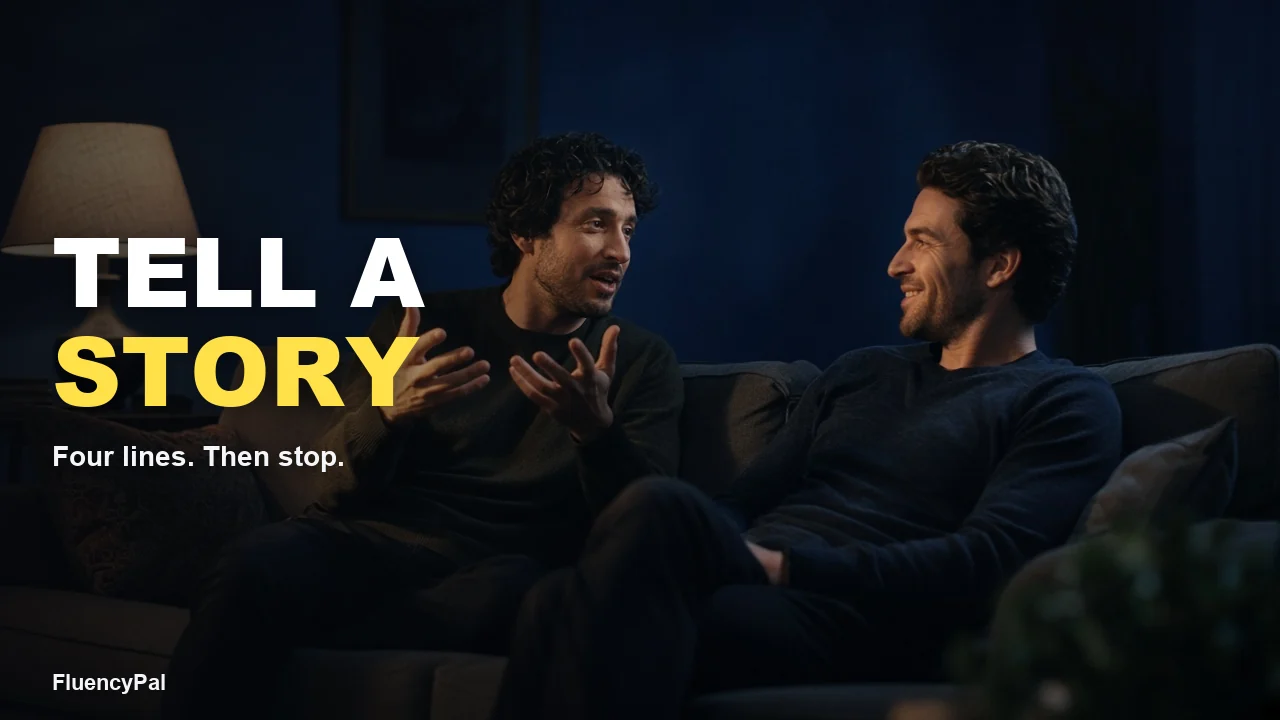
People ask you for stories more often than they ask you for grammar. What happened with the client. How was the trip. Why are you laughing. A story in speech is not an essay and it is not a joke you must land. It is a short sequence another person can follow. If they can follow it, you can add color later. If they are lost at the second sentence, color makes it worse.
The four-line story
Use this until longer stories stop falling apart. Four lines, past simple for the events.
- When and where. Yesterday, at the station. Last winter, at my sister's flat. This morning, in the meeting.
- The ordinary moment. What you expected. I thought the train was at eight.
- The change. What went differently. The board said it was cancelled.
- The end. What you did, and one feeling if you want it. I took a taxi. I was annoyed, and then I was fine.
This morning, in the kitchen, I poured coffee before I checked the cup. The cup already had tea in it. I drank it anyway. It was terrible.
That is a complete story. You can stop. Stopping is a skill. Learners often cannot find the end, so they add "and yeah" and another cause. Pick the end before you start. The end is the result, not the moral. "I learned that I should slow down" is optional and often weaker than the terrible cup.
Past simple is the spine
For a finished story, past simple carries the events. "I arrived. I saw. I left." Present perfect is for a result that still matters, or an experience with no time. If you mix them in the same short story, the listener loses the timeline.
Clear: I lost my keys yesterday. I found them in my coat this morning. Muddy: I have lost my keys yesterday and I have found them.
Time words like yesterday, last night, and this morning want past simple. There is a longer contrast in present perfect vs past simple. For storytelling practice, you can obey one rule: if you said when it happened, use past simple for what happened.
Background, the thing that was already true, can be past continuous. "I was waiting, and then the board changed." One continuous is enough. A story made only of "was doing" has no events.
Make the listener see one detail, not ten
A spoken story dies under lists. Choose one concrete thing.
- Not: the station was big and modern and crowded and loud.
- Yes: a child was sitting on a suitcase that was bigger than him.
One detail does more than five adjectives. If you cannot find a detail, you are still summarizing in your first language. Look at the scene and name an object. The cup. The suitcase. The email subject line. Objects keep you in English. Abstractions send you back to translation. That move is also in how to think in English.
When someone interrupts
Real listeners interrupt. "Wait, where was this?" "Who is Maria?" Treat the question as part of the story, not as failure.
- Answer in one line.
- Then point back. "So, the train was cancelled."
"So" here is a real return, not a filler. If "so" is your filler everywhere, you can say "Back to the train." The point is the return. Do not restart from your childhood.
If you lose the word for an object, describe it and keep the ending. "The machine you buy tickets from was broken. So I spoke to a person." What to do when you forget a word belongs inside stories, because stories are where the missing noun hurts.
Practice that builds an ending
Day 1. Tell the coffee-cup story, or a true one of the same size. Four lines. Record it. Listen only for this: did I say when, and did I stop?
Day 2. Tell a work story with the same shape. No jargon in line 1. "Yesterday, on a call" is enough. The change is the interesting part. The setup should be short.
Day 3. Tell day 2's story again. Add one object. Remove one adjective.
Day 4. Ask a friend, or an AI, to interrupt once with "who?" or "when?" Practice the return line.
Day 5. Tell a new story in under forty seconds. If you go over, the setup is too long. Cut line 2, not the ending.
A supportive friend scene is a fair place to tell something that actually mattered, because the other voice will ask a human question. Keep the four lines anyway. Emotion does not require a longer structure. It requires a true ending.
More guides
- Present perfect vs past simple
- How to give an opinion in English
- Common mistakes when speaking English
Say one example out loud
Pick one line from this page and change it so it is about your day. Say it once without reading. If you want a follow-up after that, FluencyPal can continue in a call or a voice message on Speaking with AI. A daily lesson stays on one pattern, then asks you to talk for a couple of minutes. The free plan includes a limited number of speaking messages. Paid Practice access is one payment and does not auto-renew. Current amounts are on the pricing page.
Author: Alex Dmowski
Co-Author: Grok 4.7 (Drafting and editing)
Published on: November 3, 2026
