English Phrases for Meetings: Agree, Disagree, and Interrupt
Short lines for real meetings: taking a turn, checking you heard, disagreeing without a speech, and closing your point.
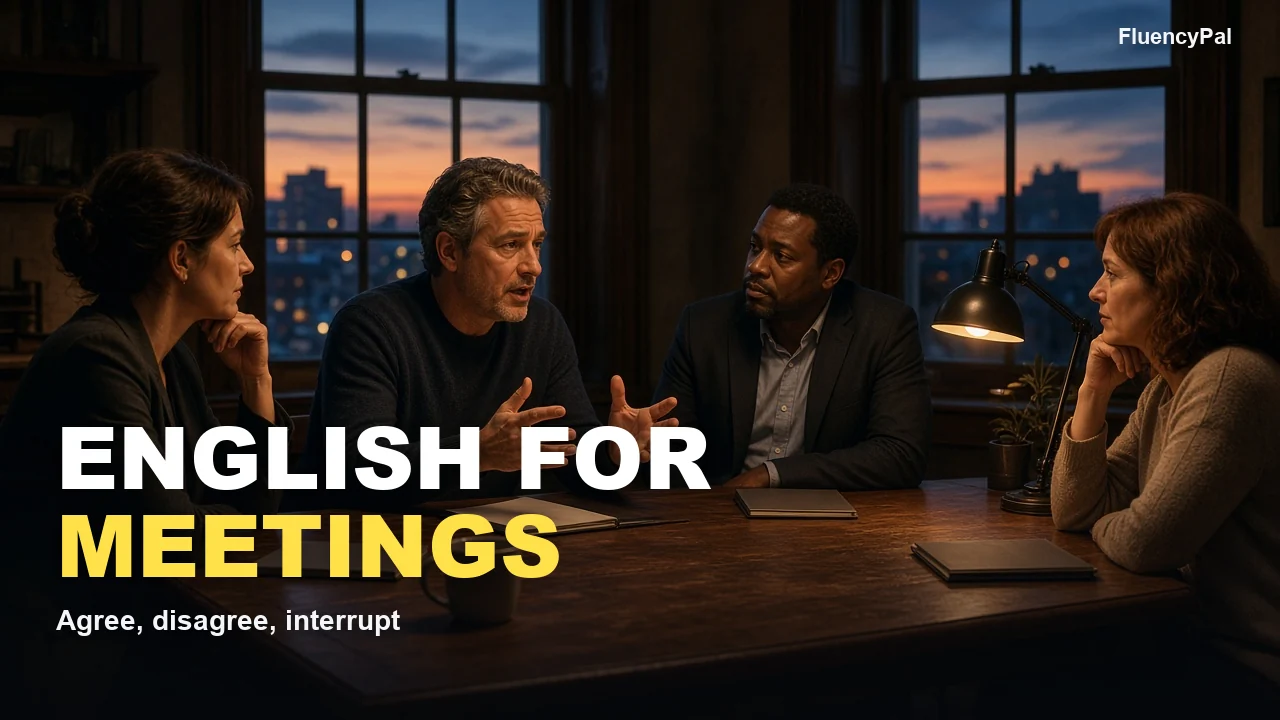
Meetings go badly in English for a boring reason. You understand the topic. The turn moves faster than your sentence. By the time you have a careful opinion, the room is on the next item. The fix is a set of short lines you can say while the opinion is still forming, plus a structure for the opinion that does not need a speech. This is not a list of fifty idioms. It is the lines that buy you a turn and the lines that end one.
Take a turn without apologizing for existing
You do not need "Sorry, I just wanted to maybe say something if that's okay." You need a clean entry.
- Can I add something?
- On that point...
- Before we move on...
- I'd like to answer that.
Then speak. If you add three more hedges, the room will fill the silence with someone else. One entry line, then the point. English filler words matter here, because "um, so, yeah, I think, like" spends the turn you just asked for.
If you missed a word, do not reconstruct the whole meeting in your head.
- Sorry, I missed the last part. Could you repeat the date?
- Just to check, we're talking about the March plan, not April?
Checking is professional. Guessing the wrong month is the expensive version of politeness.
Agree, and say what you are agreeing with
"I agree" alone is invisible. Attach it to their point so they know you were here.
- I agree with the deadline. The design can wait.
- Yes, and the risk is the data, not the layout.
- That matches what we saw last week.
"Yes, and" is more useful than "yes, but" when you actually agree and want to add a piece. Save "but" for a real difference.
Disagree in one breath
Disagreement fails when it starts with a long apology or a lecture. Use a soft start, then a clear difference, then one reason.
- I see it differently. The delay is in testing, not in design.
- I'm not sure about that. We tried it in June and the customers wrote to us.
- Can I push back on the date? Two weeks is enough for the text, not for the translation.
You do not have to say "with all due respect." It often sounds colder than a plain sentence. You also do not have to say the person is wrong. Say which part you see differently.
Then stop. Let them answer. If you keep explaining, you are giving a presentation inside their turn, and they will stop hearing the reason. A short update shape is in how to give a short update in English. Opinions with a reason and an example are in how to give an opinion in English.
Interrupt when you must
Interrupt for two causes: you will lose the decision if you wait, or you did not hear and the decision is happening anyway.
- Sorry, can I jump in? If we decide the date now, we should include translation.
- Sorry to interrupt. I didn't catch the number.
Say "sorry" once, then the content. Do not describe your interruption. "I know I'm interrupting and I hate to do this but..." is another meeting.
If someone interrupts you, you can finish or you can mark the place.
- Let me finish this one point.
- I'll come back to the cost in a second.
Both are calm. Choose one before the meeting so you are not inventing it while your heart is loud.
Close your own point
Meetings reward people who end.
- So my suggestion is Friday.
- That's the main risk.
- I can send the list after this.
If you do not close, someone will summarize you incorrectly, and you will notice in the notes. The close is one sentence. Write it in your notes before you speak, in words you can say. "The suggestion is Friday" survives nerves better than a sentence you admired while typing.
Rehearse a meeting you actually have
Pick a meeting from this month. Write four lines only:
- Your entry.
- Your point, with one reason.
- The disagreement, if you have one, in the soft-start shape.
- Your close.
Say them aloud once. Then do it with resistance: another person, or a scene, disagrees. Custom conversation can be that meeting if you describe who is in the room and what they want. A colleague who will stay in the role for five minutes is better. Give them permission to interrupt.
Do not collect more phrases after this. Four lines you can say under pressure beat a document of elegant ones you cannot start. If the meeting is really an interview, use the rehearsal in English job interview practice instead. A status meeting and a hiring conversation are different genres.
More guides
- How to give a short update in English
- How to describe your job in English
- Polite English for difficult moments
Say one example out loud
Pick one line from this page and change it so it is about your day. Say it once without reading. If you want a follow-up after that, FluencyPal can continue in a call or a voice message on Speaking with AI. A daily lesson stays on one pattern, then asks you to talk for a couple of minutes. The free plan includes a limited number of speaking messages. Paid Practice access is one payment and does not auto-renew. Current amounts are on the pricing page.
Author: Alex Dmowski
Co-Author: Grok 4.7 (Drafting and editing)
Published on: November 3, 2026

