Best Apps for English Job Interview Practice
How to rehearse answers that survive a changed question, what to practice out loud, and which tool to use the week before the call.
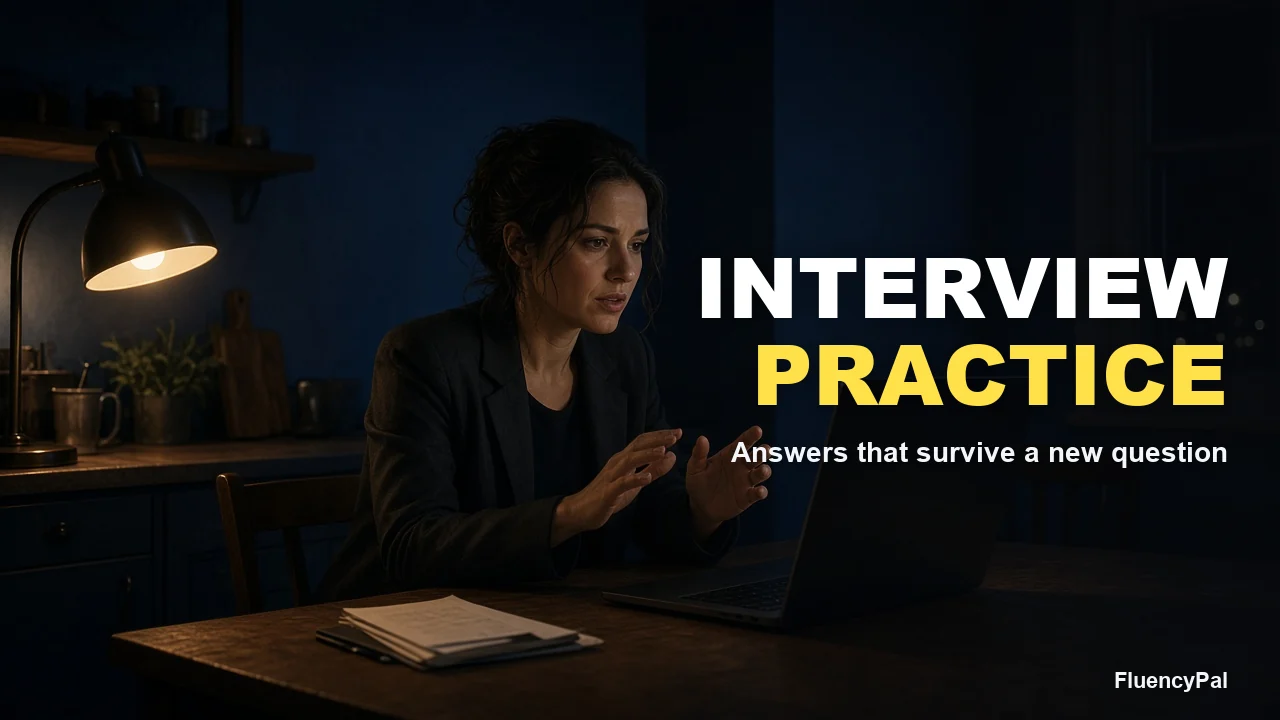
An interview in English fails in a specific way. You know the story of your work. You prepared a paragraph. The interviewer asks the same idea from another side, and the paragraph does not fit, so you go quiet or you recite something slightly wrong. Apps help when they let you practice that moment. They waste your week when they only quiz you on polite phrases.
This is a practice plan for the week before a real interview, and a way to choose tools without collecting them. Phrase lists still matter. They are not the rehearsal. A phrase collection lives in phrases for an interview in English, and a longer prep guide is how to ace an English job interview. Read those for lines. Use this page for reps.
What you are rehearsing
You are not rehearsing a script. You are rehearsing a structure you can refill.
Tell me about yourself. Four beats, under a minute:
- What you do now, in one sentence a non-specialist can repeat.
- One proof: a project, a number you are allowed to share, a responsibility.
- Why this role, tied to that proof, not to "I am passionate."
- Stop. Silence is allowed. Do not add your life story.
Example:
I am a support lead for a payments product. Last year my team cut the time to resolve billing tickets by tracking the three errors that caused most of them. I want this role because you are dealing with those same billing delays, and I have already built that kind of queue.
Say it. Then change the job title in the question. "Tell me about a project" should be able to reuse beat 2 without the rest of the script. If it cannot, you memorized a speech.
A behavioral question. Situation, what you did, what changed. One story, two minutes, then a shorter version of forty seconds. Interviewers interrupt. The forty-second version is the one you will actually need.
A question you ask them. Prepare two. One about the work ("What does a good first month look like?"), one about the team ("How do you decide what to fix next?"). Asking nothing reads as fear, even when it is only language fear.
Common ways this falls apart in English, apart from the story, are listed in five interview mistakes. Use that list as a checklist after a recording, not as something to recite.
Which tools are for which part
A phrase app or a course can stock the small lines: "Could you repeat that?", "I haven't worked with that tool directly. I have done something close.", "Let me think for a second." Drill ten of them, out loud, until they are boring. Then leave the course. More units will feel like preparation and will not be.
A recorder is the minimum viable tool. Phone, voice memo, the questions written on paper so you are not reading the answer. Most people skip this because hearing yourself is unpleasant. The unpleasantness is the information.
An AI mock interview is the right tool when you need a person-shaped interruption and you do not have a friend who will stay in character. FluencyPal's job interview role play is this job: you speak, the interview continues, you cannot lean on a paragraph you wrote in your first language and then translated on screen. Custom role play is better if the real interview is not a generic hiring chat — a technical screen, a client call, a salary conversation. Put the real constraints in. "You are a hiring manager. Ask me about a conflict. If my answer has no result, ask what changed."
A general chatbot can do this if you give it rules. The rules in best AI English tutors apply, with one change: it may interrupt you, and it should not rewrite your answer into corporate poetry. You want a simpler sentence, then you say it yourself.
A human is worth money if the interview is high stakes and you can book them before the date, not the night before. Bring the recording of your "tell me about yourself," not a request to "do a general lesson." How to split humans and AI is in italki vs AI English practice.
A pronunciation app is worth a little time only if a specific word in your field is getting lost — a product name, "third," "priority." It is not interview practice. See ELSA Speak review.
A five-day plan
Assume the interview is soon. If it is not, stretch each day.
Day 1. Write the four beats of "tell me about yourself" in English you can say, not English you can admire. Record three takes. Keep the take that is clear, not the take that sounds like a commercial. Note one sentence to simplify.
Day 2. Behavioral story, long version and short version. Record both. The short version is the one to make smooth.
Day 3. Open a mock interview. Answer "tell me about yourself," then survive two follow-ups. If you panic, say "Let me think for a second," and think. That phrase is part of the practice. Do not apologize for your English. Apologies spend time you needed for the example.
Day 4. The questions you will ask them. Record them. Then do one inconvenience drill: the interviewer asks something you did not prepare. Your job is a clumsy true answer, not silence. "I have not led a team of that size. I have led three people on the billing project, and here is how we split the work."
Day 5. One full run, shorter than you want. Listen only for three things: Did I answer the question they asked? Did I include a proof? Did I stop? Fix one issue. Sleep.
FluencyPal can be days 3 and 4. The free plan has a limited number of speaking messages, which may be enough to see if a mock feels different from a memo. If you are going to rehearse all week, Paid Practice access is one payment and does not auto-renew. Check pricing rather than trusting a number in an article. A friend on a video call is still a complete tool.
The night before
Do not learn new phrases. Say the four beats once. Say the short behavioral story once. Prepare the room: water, the link, a note with the two questions you will ask. If you miss a word in the interview, ask for it. "Sorry, could you say that last part again?" is a professional sentence. It is in the phrase guide for a reason.
After the interview, if you want, record what you wish you had said. That recording is the start of the next one. It is also ordinary speaking practice. The interview was a scene. The skill carries.
More guides
- Phrases for an interview in English
- How to ace an English job interview
- Five common English interview mistakes
- 6 ways busy professionals practice for interviews
About this guide
FluencyPal publishes this article, and FluencyPal is one of the tools it describes. There is no star rating here, and no invented price for another company. Lesson lists and prices change. Read the product's own page before you pay. Judge a tool by the action it asks for in fifteen minutes: tap, listen, read, or speak.
Author: Alex Dmowski
Co-Author: Grok 4.7 (Drafting and editing)
Published on: November 3, 2026