How to Practice English Pronunciation
Stress, linking, and a few sounds that change meaning — a two-week drill with your phone, and where a scored app fits.
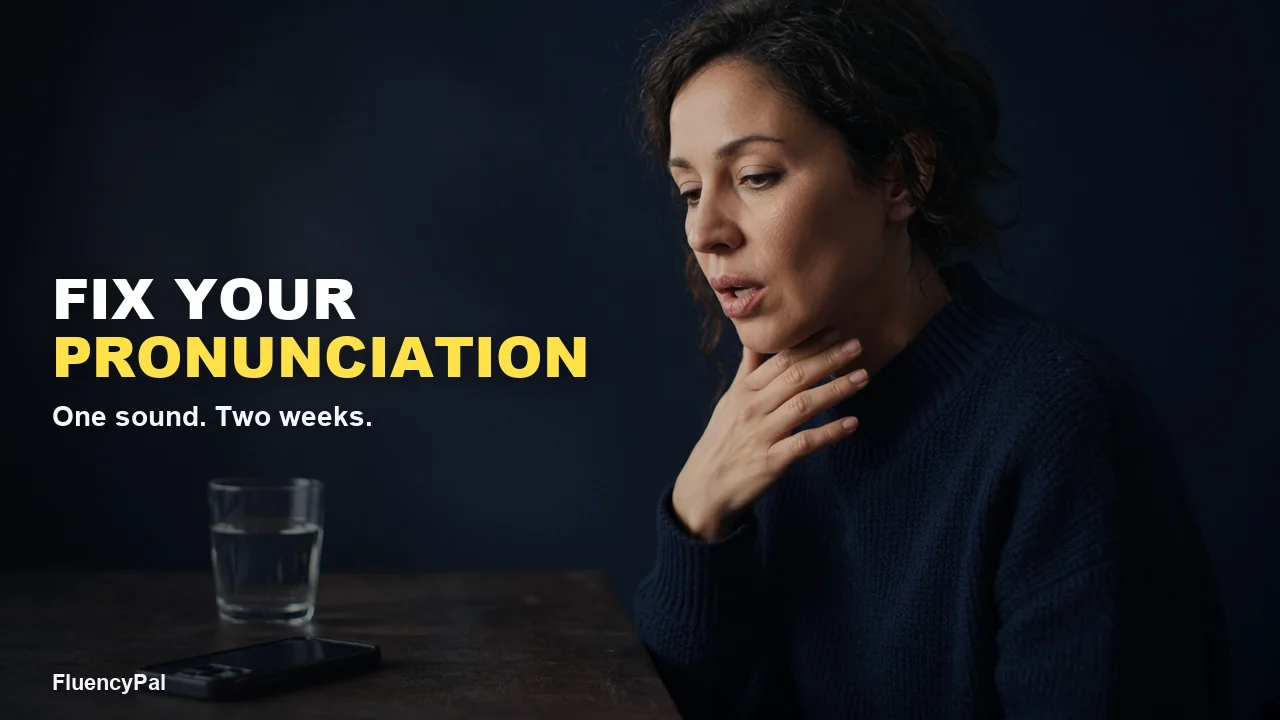
Pronunciation practice goes wrong in two directions. People ignore it and hope conversation will sand the sounds down. Or they buy an app, chase a score, and stop having conversations. You need a small amount of precise work, inside sentences you would actually say. This is that work. It uses a phone recorder. A scored app is optional and comes after you can hear yourself.
What to fix first
Do not start with "reduce my accent." An accent is the whole shape of your speech. Listeners get lost on a few recurring things:
- A sound that changes the word. ship and sheep, live and leave, think and sink, full and fool, coat and code. Pick a pair you have already seen confuse someone, or a word from your job that people ask you to repeat.
- Stress on the wrong syllable. REcord the noun, reCORD the verb. "I will preSENT the PREsent" is the classic classroom line. More useful: the words you say at work. Photograph the stress with capitals in your notes: comMITtee, deVELop, INteresting. Check a dictionary if you are unsure. Guessing trains the wrong muscle.
- No linking. English words in a sentence lean into each other. "Want to" is not two statues. If you pronounce every word as in a list, people hear the words and still find the sentence hard. You do not need a linguistics course. You need to copy one short sentence's music.
Leave th-sounds and vowel charts alone until one of these three is chosen. One target for two weeks.
Week one: hear it, then say it in a true sentence
Day by day, ten minutes.
- Find a model. A dictionary audio button is enough. A tutor saying it once is enough. A line from a show where the word is clear is enough. Listen three times.
- Record the model if you legally can for your own study, or just play it, then record yourself saying the word five times. Many phones make this annoying. Annoying is fine.
- Play yours, then the model, then yours. If you cannot hear a difference, stop. More repetition will carve the wrong sound deeper. Get a human to imitate you and then imitate the target. One correction of the ear is worth fifty blind reps. This is also why a score you cannot interpret does not help yet. That limit is the center of the ELSA Speak review.
- Put the sound in two true sentences. Not "the sheep is on the ship." Something you mean. "I leave at six." "I live near the river." "I think the estimate is wrong." "Please sink this section of the doc" is a bad example. Use a sentence you could say on a weekday.
- Record the sentences at a normal speed. Slow practice is for step 2. Conversation speed is step 5. If you can only say it slowly, you cannot say it in a meeting.
On day 5, shuffle the recordings and point to which sentence you hear. If you fool yourself, the pair stays for week two. If you do not, add stress or linking as the new target, but do not add a second sound pair. Greed is how pronunciation week becomes a chart.
Week two: stress or linking, then a story
If the pair is still messy, repeat week one with the same pair. New sentences, same sound. Boredom means the dose is right.
If the pair is audible, switch to music.
Stress. Take four words you need at work. Mark the stress. Say each in a sentence. Then say a four-sentence update in which those words appear. Record the update. Listen only for those words. Example:
I'll send the estimate today. The committee meets on Thursday. We need to develop a simpler page. The interesting part is the delay, not the color.
Linking. Take one sentence you say often. "I wanted to ask you about the deadline." Copy a fluent speaker's version, or just speak it as one piece instead of six announcements. Record the choppy version and the linked version. The linked one should be easier for a friend to hear even if individual vowels are still yours.
Then tell a two-minute story that includes the target. The story is not allowed to be a list of minimal pairs. It is about yesterday. This is where pronunciation meets speaking, and where people hide. The speaking method, if the story collapses for reasons that are not sounds, is how to practice speaking English alone.
Where apps fit
Buy or open a pronunciation app if all of these are true: you can hear the gap, you will do boring reps, and you want a reminder. Use it as the ten-minute drill, not as your entire English life. If the app only offers random sentences, paste or choose ones that contain your pair. Random "the rain in Spain" work is how you become good at demo sentences.
Do not buy an app to avoid a conversation. A high score and a silent week is a loss. FluencyPal will not score your vowels. Treat any claim that it does as a misunderstanding. Use it, if you use it, for the two-minute story and the follow-up: Speaking with AI. If the story fails because of grammar rather than a sound, take that mistake into grammar practice on another day. Mixing all feedback in one sitting makes you quiet.
A tutor is the better purchase when your ear cannot catch the pair after three days of the model-and-you comparison. Book one session with the pair written down. Ask them to imitate your version and the target. Record that session. The rest of the month you drill from that recording. Marketplaces and how they compare with AI are in italki vs AI English practice.
What "better" will feel like
It will not feel like a new identity. It will feel like one word that no longer causes a replay. Ask a colleague or a friend, if you have a kind one, "Last month you asked me to repeat this word. Is it clearer?" If you have no one to ask, compare your day-1 and day-14 sentence recordings and be strict: can you tell which word you meant with your eyes closed?
Keep the accent. The goal is a sentence a patient person gets the first time. After that, spend your minutes on ideas. Pronunciation as a permanent main course is a way to never have the conversation you are preparing for.
More guides
About this guide
FluencyPal publishes this article, and FluencyPal is one of the tools it describes. There is no star rating here, and no invented price for another company. Lesson lists and prices change. Read the product's own page before you pay. Judge a tool by the action it asks for in fifteen minutes: tap, listen, read, or speak.
Author: Alex Dmowski
Co-Author: Grok 4.7 (Drafting and editing)
Published on: November 3, 2026