Second vs Third Conditional: If I Were vs If I Had
Unreal present vs unreal past — clear rules, spoken examples, and the mixed forms you hear at work.
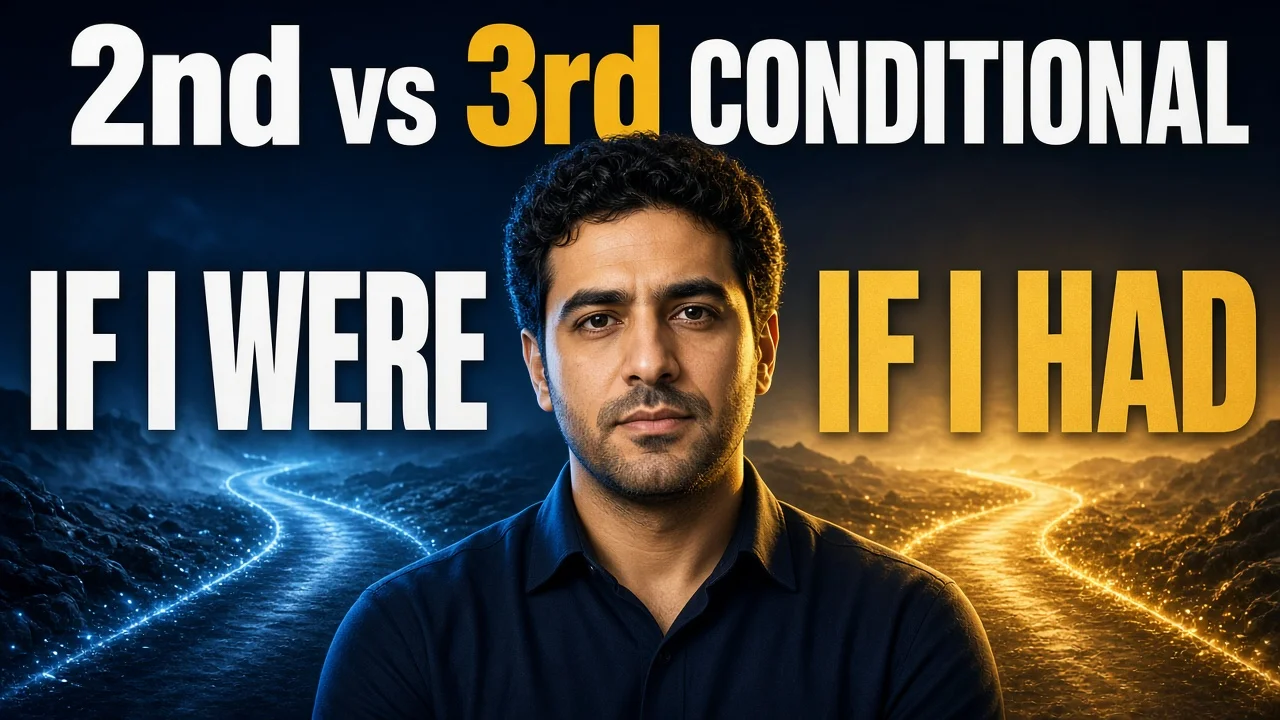
Conditionals are how English talks about imaginary presents and imaginary pasts. In speech, the useful split is this:
- Second conditional: not true now (or very unlikely).
- Third conditional: not true then — you are looking back.
If I were you… that's second conditional. If I had known… that's third conditional. Mixing the two is one of the most common advanced-sounding mistakes.
The short rule
Second conditional: If + past, would + verb
(imaginary present or future)
- If I had more time, I would rewrite the intro.
- If she were here, she would explain it.
Third conditional: If + had + past participle, would have + past participle
(imaginary past — too late)
- If I had had more time, I would have rewritten the intro.
- If she had been here, she would have explained it.
Same idea. Different time. That is the whole lesson.
If I were vs if I was
In careful English, unreal be is were for every person: If I were, if he were, if it were.
- If I were you, I would take the offer.
- If it were cheaper, we would buy it.
If I was appears in casual speech. It is widely understood. In interviews, presentations, and written follow-ups, If I were still sounds more controlled. Practice were until it is the one you reach for.
Do not confuse this with a real past: If I was rude yesterday, I am sorry. That was is a real possibility, not an imaginary present.
When to use the second conditional
Use it for advice, hypothetical jobs, polite distance, and “not my real situation.”
- If I worked there, I would ask for a clearer brief.
- If we moved the meeting, more people would join.
- If I didn’t need a visa, I would go next month.
The past tense here is not about yesterday. It is a signal: this is not real.
When to use the third conditional
Use it for regret, blame, relief, and “that ship has sailed.”
- If I had seen the email, I would have replied.
- If we had tested it, we would not have shipped that bug.
- If you had told me, I would have waited.
The event is closed. You cannot change it. You can only comment.
Mixed conditionals (what you hear at work)
People often mix times on purpose.
Past condition, present result
- If I had taken that job, I would be in London now.
Present condition, past result
- If I were more organized, I would have sent this yesterday.
These are useful. They are not a license to randomly combine would and had. Keep one half clearly past and one half clearly present.
Side-by-side examples
| Meaning | Second (now / future) | Third (past, too late) |
|---|---|---|
| Time | If I had a spare hour today, I would review it. | If I had had a spare hour yesterday, I would have reviewed it. |
| Advice | If I were you, I would wait. | If I had been you then, I would have waited. |
| Missed chance | — | If we had applied earlier, we would have got an interview. |
| Unreal present | If the app were faster, people would stay. | — |
Mini speaking drill
Read this, then tell a similar story about your own week.
If I were the hiring manager, I would ask for a portfolio, not a long CV. Last week I would have prepared better if I had known there was a case study. If we had started earlier, we would be done now.
That last sentence is mixed: past condition, present result. Keep the pieces: had started / would be.
Practice this grammar by speaking
Conditionals collapse under pressure. You start a sentence with if, then grab the wrong half.
FluencyPal Interactive Lessons train one contrast at a time — second vs third, or if I were with unreal present. You read a short how-to, read a text aloud, answer by voice, then speak for two or three minutes on a concrete topic. Feedback checks the form. The next lesson is generated from that talk, so you move to a new pattern instead of looping the same if I would have mistake.
Related grammar
Author: Grok 4.6
Published on: September 1, 2026