Track Your English Learning Progress
Four skills, assessed after every conversation and drawn as a trend you can read at a glance.
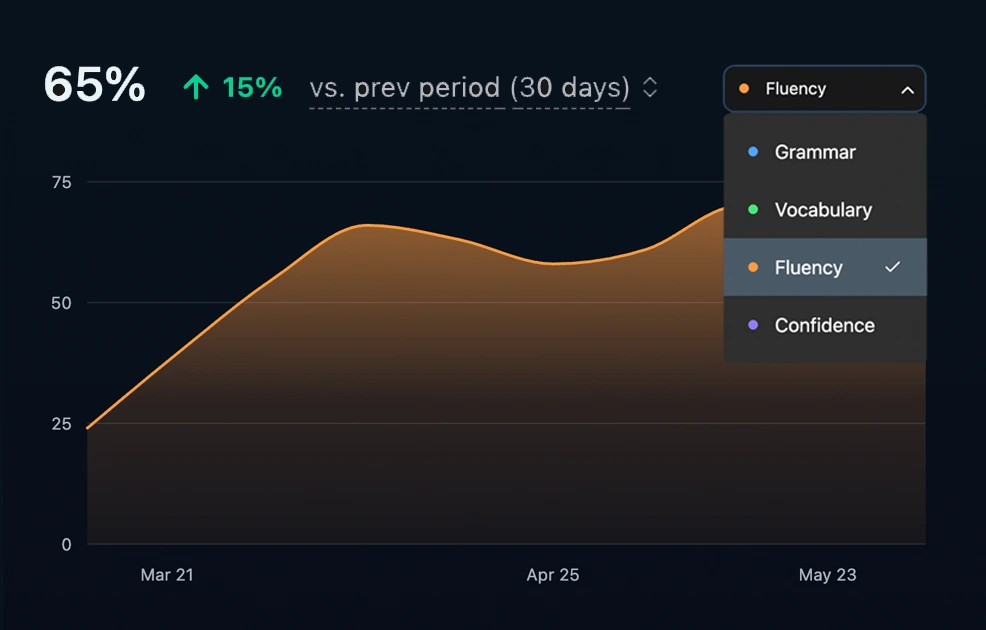
One bad call says nothing about your English; twenty calls say a lot. After conversations, role plays and daily answers, the AI assesses your skills separately and the chart turns those assessments into a timeline. A smoothed trend line shows where you are really heading.
Your progress
30 days
3 months
6 months
All time
Four skills, four lines
Grammar
How accurate your sentence structure and grammar are.
Vocabulary
How wide your range of words is, and how well they fit.
Fluency
How smoothly your ideas come out.
Confidence
How clear and assertive you sound to the AI.
Judge the trend, not the day.
Grammar climbing while vocabulary stays flat? Then the next few sessions should push new words. The confidence line describes how your speech comes across, not how you feel.
The full guide
See how your English practice changes over time
FluencyPal tracks your performance after conversations, role plays, and daily question answers. The English learning progress chart turns AI assessments into a timeline, helping you follow individual skills across your practice sessions.
What does the English progress tracker measure?
The AI assesses four areas separately:
- Grammar: accuracy of your sentence structure and grammar use.
- Vocabulary: the range of words you use and how well they fit the context.
- Fluency: how smoothly you express your ideas.
- Confidence: how clear and assertive your communication sounds to the AI.
These are AI assessments of your practice responses. The confidence score describes how your communication comes across, rather than measuring how you feel.
Compare your progress over weeks and months
Switch between skills and choose the last 30 days, three months, six months, or all time. A smoothed trend line makes it easier to look beyond individual sessions and see longer-term patterns.
Use these patterns to decide what to practice next. For example, if your grammar trend is improving but your vocabulary scores remain steady, you may want to spend more time using new words in conversation.
How can I track my English speaking progress?
Compare several sessions over time and look at specific skills, rather than judging your English from a single answer. FluencyPal brings those session assessments together in one chart.
Open your progress chart to review your recent practice and choose your next focus.
How to read your progress chart
Look at the trend line, not single sessions. One difficult conversation can lower a score for a day; the smoothed line shows where you are really heading over weeks.
Compare skills with each other. If grammar is rising while vocabulary stays flat, spend the next sessions using new words. If fluency is low, practise longer answers without stopping to correct yourself.
Choose the right time range
- 30 days shows the effect of your recent routine.
- 3 or 6 months shows real progress and plateaus.
- All time reminds you how far you have come, which helps on difficult days.
Plateaus are normal
Most learners hit periods where scores stay flat. A plateau usually means it is time to change something: harder topics, a new kind of practice, or more speaking time.
How often are my skills assessed?
After conversations, role plays and daily question answers, so the chart grows as you practise.
Does the confidence score measure how I feel?
No. It describes how clear and assertive your communication sounds to the AI.
- English Learning Community: Connect with Learners
Ask questions, share your progress, and talk about learning English with other people.
- English Learning Leaderboard: Earn Practice Points
Earn points from your learning activities and work toward leaderboard rewards.
- Personalized English Learning Plan with AI
Build an English study plan around your level, goals, and the conversations you want to have.
